We usually do theatre of the mind combat, but given the advanced notice, I decided to make a battle map for the virtual tabletop.
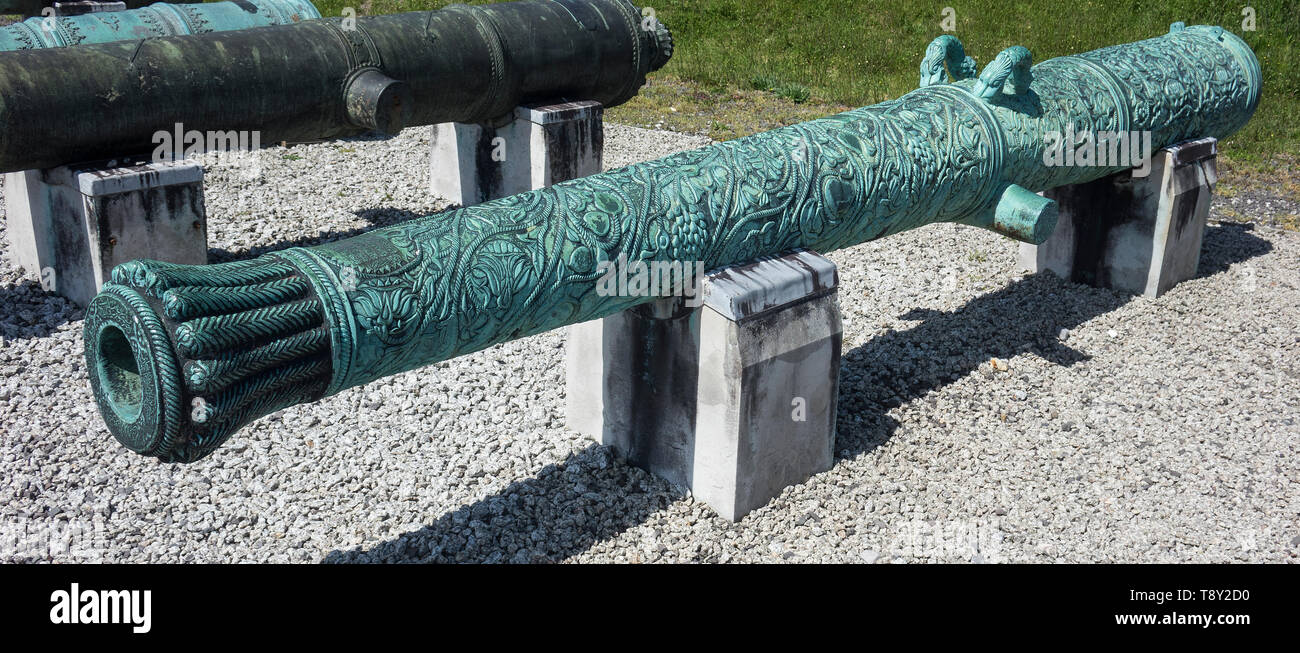
Before thinking about the map, I knew I wanted an image for the cannon. I found this online and wanted to use it. I modified it slightly in GIMP, to remove the background and concrete support under it. Also added some thorns on the side to make it look nastier.
Rather than using an aerial-view battle map (I did look at a few desert maps online) I decided to use an approach that I used once before and liked: I take a image which sets the vibe for the location, even if it isn't a suitable viewpoint / angle, and layout the battle grid / zones on it. It's more abstract, but I like the result.
Here's how it looks:

I found the original here.
There's an hourglass token at the top to indicate the phase of the day (just before nightfall). The background gives a feel for what the area looks like. I added hexagonal zones (one move action to move to a neighbouring hex), but I didn't fill the entire image with them, mainly because I thought it looked nicer to not overcrowd the space, but that comes up later and I'll talk about it then. In the bottom right, there's a key to explain that some hexes are higher ground, and that gives a bonus attack die for ranged attacks, and it is one move slower to move uphill. (For anyone keeping track of rules-as-written vs homebrew, I consider the bonus for ranged attacks to be a reasonable application of an existing rule, and the slow movement uphill is just something simple I've added here.)
The PCs (and some NPC allies) are lying prone at the top of a hill, looking down at the group with their cannon. (The players' side hasn't been observed yet.) The three knights are Aurelius, Archibald, and Raegar. I won't go into detail on the others. Behind them is their own warband - the Jizamurai - a fairly bloodthirsty lot that were established by Aurelius over an Age ago.
I often use chess pieces as tokens. I think it's a nice touch for the knights, but it also gives a quick visual indicator of how formidable someone might be (a pawn or a capital piece). There are also some "plate wolves" represented by one of the default tokens in Owlbear Rodeo.
Incidentally, plate wolves are a creature that come from one of the Myths. In the book, they're called "iron hounds". When the Company first encountered them, I didn't name them, and later asked the players how their characters would name them. I think that's a fun way to name things. I'm sure that idea has been described in many places, but I first came across it in Trophy.
The map isn't too complicated. Most of the hexes have no features, and it did occur to me that it might just lead to everyone moving towards each other, colliding in the centre hex, and dispensing with the need for a map. I wasn't worried about that. Firstly, I know the combat in Mythic Bastionland well enough to know that it would still be interesting and fun, and secondly, I'm spoiled by having players that do this:

This is the map after meeting the players. The red lines are from planning how the enemy may move, and possible lines of attack.
If you look closely at the bottom right, you can see another hex has been lightly drawn in. This followed a question about what is there, and I just said it's similar to the neighbouring dark hex. The map is abstract enough that you can extend it pretty easily (or even just place the tokens in the rough area of that hex), and I didn't want to introduce some kind of hard boundary that would have a tactical impact on things.
On the high ground, where the PCs and their allies are, they have marked in blue boxes with notes about cover. This followed a discussion about places to hide up there, and I used luck rolls to determine what was available. The results weren't too favourable: two hexes with options to conceal a single person, and one with an option to conceal half a warband. (Not wanting to make things too complicated, I said that if their warband was split between half hiding in a trench and half exposed, and there was a fight, then their attacks would be Impaired.) This addition to the battlefield reminded me a little of Fate, where players can contribute to the environment. In our game, the players asked what was available, and I left it to chance. I could have used GM fiat to say "Nope, nothing here", but I had deliberately chosen that background image which I think implies more than just a featureless sand dune.
Maybe having a sparse battle map encourages some collaboration. If I had gone to greater lengths to add features in various hexes, maybe there wouldn't have been that same search for terrain aspects to leverage.
They planned how to proceed: Wait for nightfall. Archibald and Raegar would circle in from the North, under cover of darkness, while Aurelius would create a diversion to draw the plate wolves uphill to him. Then the Jizamurai would charge in. (Re: the diversion - Aurelius can breath fire, which is the sort of thing that comes about when messing around with Myths since his days as a squire.)
Let's jump ahead to the final state of the map:

Almost everyone did end up in the same hex, but not until the final round, and there were attacks made and enemies defeated in four hexes. Archibald and Raegar had a riding battle against the plate wolves, both risking Fatigue to Deny attacks made against their steeds. Aurelius created his flame diversion and lay in wait for another plate wolf (more on that below). The green and red tokens are a quick addition that one player helpfully cooked up to track who had acted on each turn. Owlbear Rodeo makes it pretty easy to add statuses (like the plate wolf who lost an eye) straight into the token names. Quilfrey, an elderly NPC, is tucked away at the bottom left of the map, as he was sent back to the seat of power with the Story Knight's (Archibald) book of stories, in case they all died in battle.
You might also notice one additional creature - the snake - on one of the high ground hexes. Just before sunset, the Story Knight used his Ability to say that he'd heard of tales of two strange creatures in this area. One is a kind of explosive firefly, and the other a snake that is attracted to (and unharmed by) fire. The Ability means that one of these tales is true. This led to the fun situation where Aurelius lit a diversion fire, and hid for an ambush, and then unexpectedly had a snake slithering on top of him while he had to remain silent and unseen.
The allied warband, the Jizamurai, charged in and were able to surround the enemy commander. They had been ordered to take him alive, but their battle rage (and an unfortunate roll) led to a bloodier outcome.
Near the end of the battle, Raegar the Horn Knight blew his horn, which doubles Vigour loss from all attacks. (He used to do this at the beginning of fights, but he's learned from experience on that!) This made it possible for Aurelius to finish the battle with a mighty Smite attack against the warband, reducing them to 1 Vigour.
It played out favourably for the players. The enemy force never hit too hard, but the tension held up throughout. I particularly liked how this one battle played out more as three separate engagements: (i) the diversion and fight on the hilltop, (ii) the horseback fight with two plate wolves, and (iii) the warband charge. Splitting up meant that units were isolated and had a couple of rolls gone another way, things could have gone very differently.
There's a Chekov's Gun element to the whole thing - They planned for the cannon to take aim and fire at them, and had it done so, I think anyone in the targeted hex would have been in serious danger. They tried to get as close as possible while maintaining the element of surprise. Also, when Aurelius killed a plate wolf on top of the hill, the gunner in control of the cannon cried out in pain (for mysterious reasons) and didn't recover quickly.
Later, we had a little discussion about whether this battle is significant enough to earn them a point of Glory. I think some stuff I've said on The Smiling Fox makes it sound like I am stingy with Glory, but my players seem to have an "All in a day's work!" attitude, where they don't push for it at all. Some more discussion to be had on this anyway, as it all links into a Myth as well.