Friday, 5 June 2026

Liberating a giant cannon

This week we played session 45 of our Mythic Bastionland campaign. This was a rare occasion where I had a good idea of what the Company would be doing next. In session 44 they followed strange tracks in the desert that led them to a warband with a huge artillery cannon (unfamiliar technology to the knights). They're looking for ways to protect the realm against two other military threats, so when presented with a new weapon they thought, "Let's have that!"

We usually do theatre of the mind combat, but given the advanced notice, I decided to make a battle map for the virtual tabletop.

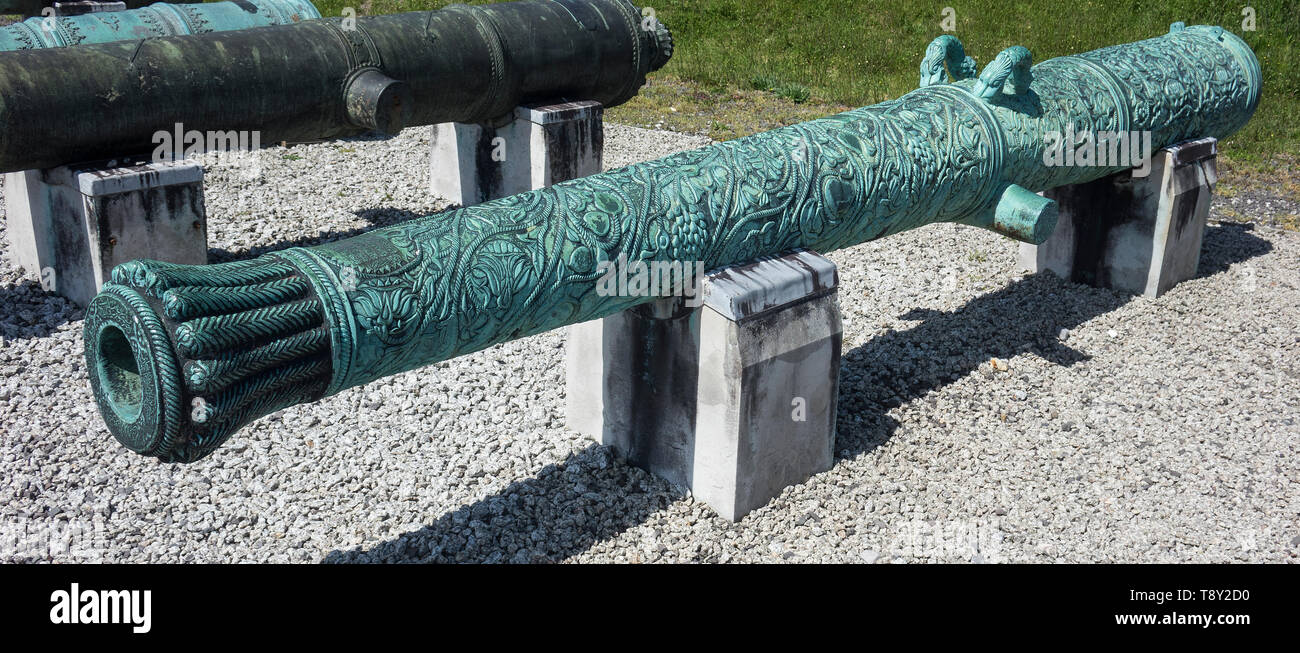
Before thinking about the map, I knew I wanted an image for the cannon. I found this online and wanted to use it. I modified it slightly in GIMP, to remove the background and concrete support under it. Also added some thorns on the side to make it look nastier.

Rather than using an aerial-view battle map (I did look at a few desert maps online) I decided to use an approach that I used once before and liked: I take a image which sets the vibe for the location, even if it isn't a suitable viewpoint / angle, and layout the battle grid / zones on it. It's more abstract, but I like the result.

Here's how it looks:

I found the original here.

There's an hourglass token at the top to indicate the phase of the day (just before nightfall). The background gives a feel for what the area looks like. I added hexagonal zones (one move action to move to a neighbouring hex), but I didn't fill the entire image with them, mainly because I thought it looked nicer to not overcrowd the space, but that comes up later and I'll talk about it then. In the bottom right, there's a key to explain that some hexes are higher ground, and that gives a bonus attack die for ranged attacks, and it is one move slower to move uphill. (For anyone keeping track of rules-as-written vs homebrew, I consider the bonus for ranged attacks to be a reasonable application of an existing rule, and the slow movement uphill is just something simple I've added here.)

The PCs (and some NPC allies) are lying prone at the top of a hill, looking down at the group with their cannon. (The players' side hasn't been observed yet.) The three knights are Aurelius, Archibald, and Raegar. I won't go into detail on the others. Behind them is their own warband - the Jizamurai - a fairly bloodthirsty lot that were established by Aurelius over an Age ago.

I often use chess pieces as tokens. I think it's a nice touch for the knights, but it also gives a quick visual indicator of how formidable someone might be (a pawn or a capital piece). There are also some "plate wolves" represented by one of the default tokens in Owlbear Rodeo.

Incidentally, plate wolves are a creature that come from one of the Myths. In the book, they're called "iron hounds". When the Company first encountered them, I didn't name them, and later asked the players how their characters would name them. I think that's a fun way to name things. I'm sure that idea has been described in many places, but I first came across it in Trophy.

The map isn't too complicated. Most of the hexes have no features, and it did occur to me that it might just lead to everyone moving towards each other, colliding in the centre hex, and dispensing with the need for a map. I wasn't worried about that. Firstly, I know the combat in Mythic Bastionland well enough to know that it would still be interesting and fun, and secondly, I'm spoiled by having players that do this:

This is the map after meeting the players. The red lines are from planning how the enemy may move, and possible lines of attack.

If you look closely at the bottom right, you can see another hex has been lightly drawn in. This followed a question about what is there, and I just said it's similar to the neighbouring dark hex. The map is abstract enough that you can extend it pretty easily (or even just place the tokens in the rough area of that hex), and I didn't want to introduce some kind of hard boundary that would have a tactical impact on things.

On the high ground, where the PCs and their allies are, they have marked in blue boxes with notes about cover. This followed a discussion about places to hide up there, and I used luck rolls to determine what was available. The results weren't too favourable: two hexes with options to conceal a single person, and one with an option to conceal half a warband. (Not wanting to make things too complicated, I said that if their warband was split between half hiding in a trench and half exposed, and there was a fight, then their attacks would be Impaired.) This addition to the battlefield reminded me a little of Fate, where players can contribute to the environment. In our game, the players asked what was available, and I left it to chance. I could have used GM fiat to say "Nope, nothing here", but I had deliberately chosen that background image which I think implies more than just a featureless sand dune.
 
Maybe having a sparse battle map encourages some collaboration. If I had gone to greater lengths to add features in various hexes, maybe there wouldn't have been that same search for terrain aspects to leverage.

They planned how to proceed: Wait for nightfall. Archibald and Raegar would circle in from the North, under cover of darkness, while Aurelius would create a diversion to draw the plate wolves uphill to him. Then the Jizamurai would charge in. (Re: the diversion - Aurelius can breath fire, which is the sort of thing that comes about when messing around with Myths since his days as a squire.)

Let's jump ahead to the final state of the map:

Almost everyone did end up in the same hex, but not until the final round, and there were attacks made and enemies defeated in four hexes. Archibald and Raegar had a riding battle against the plate wolves, both risking Fatigue to Deny attacks made against their steeds. Aurelius created his flame diversion and lay in wait for another plate wolf (more on that below). The green and red tokens are a quick addition that one player helpfully cooked up to track who had acted on each turn. Owlbear Rodeo makes it pretty easy to add statuses (like the plate wolf who lost an eye) straight into the token names. Quilfrey, an elderly NPC, is tucked away at the bottom left of the map, as he was sent back to the seat of power with the Story Knight's (Archibald) book of stories, in case they all died in battle.

You might also notice one additional creature - the snake - on one of the high ground hexes. Just before sunset, the Story Knight used his Ability to say that he'd heard of tales of two strange creatures in this area. One is a kind of explosive firefly, and the other a snake that is attracted to (and unharmed by) fire. The Ability means that one of these tales is true. This led to the fun situation where Aurelius lit a diversion fire, and hid for an ambush, and then unexpectedly had a snake slithering on top of him while he had to remain silent and unseen.

The allied warband, the Jizamurai, charged in and were able to surround the enemy commander. They had been ordered to take him alive, but their battle rage (and an unfortunate roll) led to a bloodier outcome.

Near the end of the battle, Raegar the Horn Knight blew his horn, which doubles Vigour loss from all attacks. (He used to do this at the beginning of fights, but he's learned from experience on that!) This made it possible for Aurelius to finish the battle with a mighty Smite attack against the warband, reducing them to 1 Vigour.

It played out favourably for the players. The enemy force never hit too hard, but the tension held up throughout. I particularly liked how this one battle played out more as three separate engagements: (i) the diversion and fight on the hilltop, (ii) the horseback fight with two plate wolves, and (iii) the warband charge. Splitting up meant that units were isolated and had a couple of rolls gone another way, things could have gone very differently.
 
There's a Chekov's Gun element to the whole thing - They planned for the cannon to take aim and fire at them, and had it done so, I think anyone in the targeted hex would have been in serious danger. They tried to get as close as possible while maintaining the element of surprise. Also, when Aurelius killed a plate wolf on top of the hill, the gunner in control of the cannon cried out in pain (for mysterious reasons) and didn't recover quickly.
 
Later, we had a little discussion about whether this battle is significant enough to earn them a point of Glory. I think some stuff I've said on The Smiling Fox makes it sound like I am stingy with Glory, but my players seem to have an "All in a day's work!" attitude, where they don't push for it at all. Some more discussion to be had on this anyway, as it all links into a Myth as well.

Saturday, 23 May 2026

TTRPG Cryptic Crossword

I've been solving cryptic crossword clues recently on Parseword and Minute Cryptic so I've tried making my own one.

Across

5. Men or rats kneeling before old reliquary ghosts, initially (4,4)
8. Quiet! Commotion, Westward. Bring torches. (10)
9. Why fear ending? No machine can run forever, even in Sweden (4,4,6)
11. "Who, me?" ask around, meander selflessly, to process trauma (10)
13. Financial Times coverage is missing secret skirmishes (4)
14. Look inside, be Sharp, be talkative, spawn a thousand games? (4)

Down

1. Unfair abusers, chopped up with singular ease, and beheaded by bestiary salespeople (4,3,5)
2. Not an only child, but with the biggest share (6)
3. Explore the forest? Old mood, new remix (10)
4. Monsieur Sephiroth upset by corporate horrors (10)
6. O! Non-writers transformed into storytellers! Just add out-of-this-world oracles (9)
7. A misguided villain sensed in possible topics? We've got that covered. (5,3,5)
10. Disrupt the nation's lad behaviours heading for failed careers and debt (11)
12. Considering all the aspects, where would Dad be without Human Resources? (4)

There's an interactive version here.


Friday, 8 May 2026

New podcast episodes and general rambling

Here's a quick post with some rambling updates.

I released episode 8 of my solo actual play of Mythic Bastionland today. (You can find the links for subscribing here.) As I said on the episode, it's been several months since the last episode. I am making plans to get onto a more frequent schedule and I actually recorded episode 9 today. This game never goes where I expect it to. When things settle a bit (end of an in-game season maybe) I may write a longer post here about the state of the campaign and characters.

In other podcast news, we put out episode 8 of The Smiling Fox on Monday. This episode is all about spark tables and I really enjoyed this one. Pop on your headphones and immerse yourself in the hot fog

Recently, I've run two sessions of the playtest of Intergalactic Bastionland with the Smiling Fox guys. It is already a fun game and I look forward to seeing it develop further. We're planning a third session to round out the experience of life aboard the starship.

My Mythic Bastionland group game is still going strong. I mentioned a few interesting things that have happened in the Smiling Fox episode mentioned above. I have some prep to do to flesh out some of the weirder things that are simmering there. I have several half-baked sites that need a bit more detail.

I am interested in learning some layout stuff, and I'm planning to explore Typst. It may not look very suitable for RPG stuff at first glance, but someone has made a DND 5e template for it which looks quite nice, so I think plenty of other things should be possible. I plan to make a one- or two-page adventure site to learn how to use it. If it seems interesting to share, I'll write about it here.

In other tabletop news, I've been playing some board games recently: Concordia and Pax Pamir. They are complicated! There's plenty to learn from them, about rules giving rise to tactical depth, and about historical settings and themes being quite engaging. I backed the RPG Gallow's Corner recently and I could definitely see myself running a game like that which doesn't have fantasy elements.

Stonetop has been on my mind recently. There's a good interview with the creator here, and Quinns released his deep dive on it this week. This probably falls into the category of "Sounds great! Will I ever get time to play this??" for me. I am definitely drawn to long-form play, and digging into relationships and community. Though I probably do elements of that in any games that give space for it.

I'm not playing any solo game other than the podcast one at the moment. I'd like to change that soon. I'd like to try something loose and flexible, and I think Everspark might be a good one for that.


Wednesday, 8 April 2026

Earth Resists: Site recipes


Craggy cave mouth” by Thomas Quine, CC BY 2.0

As a design goal for Earth Resists, I want to think of adventure sites as recipes. The written description is not a prepared meal, it is a list of ingredients with some simple instructions. In fact, I want the site to have almost no instructions - the instructions are general and apply to any site. I'm hoping this will make sites for skirmishes easy to write, read, and run.

Here's an example. This site for a skirmish mission is a huge sinkhole and cave system in a tropical forest.

Locations:
(Would be shown as a simple diagram map, but I'm writing this on my phone)

Forest (cover 5, threat 1)
Sinkhole edge (cover 3, threat 1)
Sinkhole floor (cover 2, threat 2)
- trap: auto turret (2P)
Tunnel A (cover 4, threat 2)
Tunnel B (cover 3, threat 1)
- hazard: falling rocks (2P)
Cavern (cover 3, threat 3)

ET objective:

Protect the worm eggs in the Cavern location until they hatch (6-part clock)

ET units:

Snakehead (1P, 1HD) × 3
Spiderbot (2P, 3HD)
- special: drag away wounded (3P)
Grey worm (4P, 3HD)
- special: burrow (3P)

(Incidentally, I want ETs in the game to have descriptions but no names. It's left to the players to name them - maybe later in a campaign, if there's a linguistic breakthrough, that would change.)

What to do with all this?

After all PCs have taken a turn, the GM takes a turn. If all PCs are in 0-threat locations, the GM may choose any other location on the map and make a threat roll. Otherwise, when one or more PCs are in non-zero threat locations, the GM rolls for each of the occupied locations.

If the threat level is 2, they roll 2d6. If the threat level is 3, they roll 3d6, etc. Take the highest number (N), and the GM may use that to:

1. Deploy N points worth of ET units to the location. (Example: If the number is 3, the GM may deploy three 1-point units, some kind of minion type, or a stronger 3-point unit).
2. Check the map location for any special action which can be activated for N (or lower) points. This could be a trap or an environmental hazard.
3. Check any already deployed unit for any N (or lower) point action. Generally, already deployed units can be used freely on the GM's turn, but they may also have special abilities that require spending these points.
4. Hold some or all points of the total N in reserve, to spend on a future turn.

For a threat level of greater than 1, it is possible to have matches on the result (e.g. rolling 2d6 and getting 4, 4). Matches advance the overall ET objective in the area by one mark of progress (Example: repairing a crashed spaceship, or hatching ET eggs in the example above).

I know some folks may bristle at using a metacurrency for the GM to spend on moves and conjuring quantum ogres, but I'm thinking of it differently. I want to achieve the same outcome as running a more carefully prepared site, but without the same level of prep. The GM can glance at their ingredients and jump right in, without needing to know details about any particular location. (This may just reflect my GMing style, where I sometimes misread that kind of detail anyway, when things come up in play.)

I have yet to play test this, but it is coming together in my head, and I think I'll be able to try something soon.

Thursday, 2 April 2026

There and Back Again

There was a conversation recently in the Bastionland Discord about a Mythic Bastionland  session which the referee felt didn't go well. It sounded like they had fought a climatic battle, won, played through the return journey to the nearest holding, but didn't have the best time with the events that the return travel triggered. Of course, only the people at that table know exactly how it went, and I'm not going to talk in depth about that game because I wasn't there. But it got me thinking about the balance between tension and downtime.

I've also been reading a sci fi novel recently, which has prompted some similar thoughts. Cowl by Neal Asher is about a conflict between time travelers. Characters, who initially don't know the factions involved, get drawn into the conflict. This isn't a review, but the book didn't really click with me. It felt like too many action / survival scenes without enough downtime to break them up. (It probably would've helped to read it over a couple of days rather than spreading it out over a few weeks.)

When I say "downtime", I don't necessarily mean characters hanging around in a town and learning a skill or upgrading weapons or whatever. I just mean a shift in the tension. There may still be important stakes, but with a change to the pace or the level of threat.

If you're writing a story you can just say Bilbo Baggins travelled home and skip across half of Middle-Earth. If you're playing an RPG, and the group wants to play through that journey, then you play through it. But it helps to be on the same page about what that means:
 

- Is a fresh journey, like the outward one, filled with random encounters?
- Is it a revisiting of those locations, maybe dealing with some consequences from before?
- Is it a quieter time, to spend some time with the characters and unpack what they've experienced?

I'm sure there are other possibilities too. My experience with the sci fi novel suggests to me that I don't want the next stage of most stories to have a similar texture to the last. I like the tension to have highs and lows, and to have changing circumstances.

The question this boils down to, in Mythic Bastionland, is "Do I ever want to turn off the Myths?"

Do I get to points in the game where I feel there is enough happening and don't want another injection of weirdness to proceedings?

I think my answer is "No, but".

I have never skipped a travel roll, or ignored an omen result on a travel roll. But I do check in with the players, asking if they want to travel to their next destination in the next session, or do a short time jump (days or weeks, maybe to the next festival) to start the session there. Another aspect of the "but" is that I have, once or twice, folded an omen into ongoing matters so that it is not an entirely new thread to pull on.

I consider all of the above to be playing rules as written. But, as a thought experiment, let's make up a house rule to handle things differently.

After a dramatic resolution, or a harsh defeat, or generally any time that the Company are ready to pack up and go home, make a single d6 roll for the entire multi-hex return journey:

1. The original purpose of the journey is still not resolved, and the Company come face to face with it. This may mean twisting the meaning of some earlier event.
2. The Company encounter a new troubling issue. Something unrelated to the outward journey's purpose. Maybe an Omen, or some crisis from the spark tables.
3. A sign of new trouble. Not directly encountered, but new information to consider at home. I'm thinking spark table dramas and crises rather than Mythic stuff.
4. Encounter a feature of the realm changed by your recent actions. 
5. Same as 4.
6. Encounter a blessing, for example a character grateful for your recent actions.

After rolling, pick one of the hexes on the return journey to play out the result. These are pretty vague and would need to be fleshed out with spark table rolls.

Sunday, 29 March 2026

Between hidden roles and sandboxes

I've played two games this week that involved secret information.

First was my regular Mythic Bastionland game. The company of knights had planned to visit a town where one of them grew up. Although he's from there, this was our first session in that town. Before the session, I chatted with that player about his character's history. We decided, among other things, that when he left the town twenty years earlier to become a squire, he abandoned his fiancée. The fiancée character appeared in this week's session as a member of the town's council. We roleplayed some tension between them, but he chose not to share the background information with the other players until near the end of the session. It's was a fun note to add, but it didn't change the direction of the session.

Second was Cluedo Conspiracy. It's a hidden role board game which involves some players trying to stop a murder plot while others secretly try to execute the plot. We played with five players, so there were three good guys and two conspirators. In our first attempt at playing (we were all learning the game, and I was reading and teaching the rules) one player misspoke early on and revealed their role. We decided to reset the game and played through on the second attempt. (I quite like the game, incidentally. It's like a simplified version of Battlestar Galactica, much quicker to play.)

I think it's interesting to compare these experiences because they both involved hidden information, but they are at two ends of a scale:

  • In the RPG, some information was hidden which informs roleplaying. When the information was revealed it didn't have much impact, except as a dramatic beat.
  • In the board game, the hidden information is at the core of the gameplay. Much of the strategy of the game is based on concealing or trying to reveal that information. When it's revealed, it shifts the focus of play and impacts what choices players have afterwards. If the secret is revealed too early, because of a simple mistake, it diffuses a lot of the fun of the experience.

I'm curious to consider what might lie between these two ends of the scale, so I've been trying to deconstruct them a little.

In the Cluedo Conspiracy game, there is a binary division: Some players are tasked with killing Mr Coral and some with protecting him. It's adversarial and all-or-nothing. After the secret is revealed you have no common ground with the other team.

In the Mythic Bastionland case, you're playing in a sandbox so there aren't strict goals. Revealing that a knight once ghosted his partner could conceivably lead to some new objective, or influence how the group respond to a problem, but it is less likely to redirect the flow completely. Rather than the binary, team A or team B, it's team "here is some new information, do whatever you want".

One way to extend this is to have more than one strict objective. In the Cluedo case, you could have kill/protect Mr Coral and also steal/protect Mr Coral's treasure. You go from two opposing teams to (potentially) players with four different objectives:

  • Kill the guy, steal his money.
  • Kill the guy but because of another motive. Leave the money for his heir.
  • Protect the guy, steal the money (I'm a thief not a murderer).
  • Protect the guy, protect the treasure (we're trying to have a society here!).

In this extension, a secret could be revealed about a player without necessarily breaking the game into a completely adversarial contest. When you have some goal in common with another player, there is room to negotiate and coordinate.

Another extension, into the space between the two ends of the scale, is to make the secret information itself more complex. 

  • I want to kill Mr Coral because his true identity is a war criminal.
  • I want to protect Mr Coral so that he can be put on trial for his crimes.

This idea (more complex information) seems to tend towards play where players choose their own goals. But I'm trying to find the middle ground, not going as far as a sandbox, so maybe it looks a little more like this:

Your character has beliefs / alignment / bonds. Initially, you work with the information you have, and work towards the goal that fits those. As hidden information is revealed, you filter that through the beliefs / alignment / bonds and it updates your objectives. (This is very like roleplaying in a sandbox, but I'm imagining it as a little more mechanical / board gamey - character traits overriding player choice.) That might mean you switch from team "protect the guy" to team "kill the guy", when you get more information.

I had some more thoughts about why bothering with secrets at all, but that's kind of a tangent. Wrapping it up here!

Friday, 20 March 2026

Earth Resists: Skirmish map


A simple abstract map showing locations like Subway Station, Baseball Field. Each has numbers on them which are explained in the post.
A test map for Earth Resists (ignore the text on the bottom left)

(I believe this may be mappy enough to count for Prismatic Wasteland's map bandwagon.)

I first mentioned my X-COM inspired game here. This post collects some ideas about how I intend to handle the skirmish missions in the game. As I said before I want to lean into feelings of tension and drama rather than simulation.

The map above shows 6 locations in a North American city. This is the GM-facing version. The player-facing one would show the layout but the labels and numbers would not be present at the start (details are added to adjacent locations when they move around).

At each location there are two numbers – the top is Threat and the bottom is Cover. The Subway Station, for example, has Threat 0 and Cover 5. These numbers are known to the players (added to the player-facing map) for the location they are at, and for adjacent locations. It's information that helps them make meaningful decisions.

Cover

If a PC is at the Subway Station and wants to take cover, they roll a d6. If the result is less than or equal to the Cover number for the Subway Station (5) then they are in cover. Players can glance at the map and have a good sense of what the opportunities for cover are. But it's also not guaranteed, so there is an element of risk to balance. I'm hoping to create meaningful tactical decisions without needing a grid or defining a bunch of terrain detail in advance. There may be some ways to increase your odds of getting into cover (dedicate more time to it, have a relevant skill).

Threat

The world sheet mentioned in my first post also uses a number for Threat. I'd be tempted to use a different name for this idea in the skirmish map, but I kind of like the mirroring of things at the big scale and little scale.

If the PCs are at the Subway Station they can see the Threat is 0. This essentially means the Subway Station is safe. They won't be attacked there. Why include a safe location in a skirmish map? There are plenty of other things that could happen there – they may find civilians who need to be escorted out of the area, or interviewed for intelligence, or they may find some discarded alien technology that could be collected for research.

At the Subway Tunnel the Threat is 2. My current thinking is that after the PCs act, the GM can then roll 2d6 (one d6 for each point of Threat) and the result determines how the GM can act. The higher they roll the harder the move. Maybe a 1 is a sound of an ET moving nearby. Maybe a 6 would see the PCs coming under fire. This is kind of an initiative system, but I think if an ET shows up and is in an ongoing firefight, they won't have to rely on a Threat roll to take a turn – it's more about the unseen threats building.

Again, I like the idea that the players can see this Threat number and know what it means. They can plan an approach that tries to manage the risk.

This is a deadly game. Walking into a dangerous place, failing to get into cover, and getting shot, will likely cause a PC to be out of action. I need to do testing to see how likely that is, and how frustrating it is. But it's also designed so that new PCs can be generated very easily, so you could quickly dispatch another character from the entry point into the map (if you have enough personnel to allow for that).

Scene Transitions

I'm not sure how this will play, but I want skirmish missions to be played in parallel with other types of missions which I'm tentatively calling Shadow War missions. The skirmishes are the open warfare part of the game, and the Shadow War stuff is more focused on investigation and espionage. In a game session the GM will lay out the details of the two scenarios, players will select or roll up their characters (players will routinely be using more than one character), and then they deploy.

In the skirmish, when the PCs move from one location to another, we put the skirmish on hold and switch our attention to the Shadow War scenario. At an appropriate moment in the Shadow War scenario, the spotlight will move back the skirmish.

Example:

Seb and June are soldiers searching for ETs in the Subway Station. They see blast marks from energy weapons on the walls, and in the tunnel ahead they can see sparks and blinking lighting from a damaged train. The players look at the Subway Tunnel on the map, and see that the Threat is increasing in that direction. They decide to proceed. The GM then lays out the scene at a power plant in Australia where several engineers have gone missing. Two investigators, Dahlia and Rickard are talking to the plant director who seems likes he's hiding something.

I can imagine some players wouldn't want to shift attention away from a scene when things are getting interesting, but my hope is that multiple things will be getting interesting alongside each other. Might be tricky to work out, but I think it could be quite neat.

Friday, 6 March 2026

Earth Resists

I've been thinking for awhile about how to make an X-COM like experience in a TTRPG. I played a lot of the 1994 original back in the day, and the emergent aspects of play left a huge impression on me. I might dig into the detail of that in another post.

(I know there is already a board game based on X-COM, though I've never played it, and I would imagine there is some kind of similar RPG out there already, but I think it'll be fun to make my own stab at it.)

Here are the principles I've been trying to bring to this:

1. I don't want this to be a bunch of spreadsheets. Video games are great at simulating complicated stuff, but I want something very light. Vibes over formulas.
2. A feeling of being up against the odds, maybe even that you only have a slim chance of victory.
3. Investment in characters - surviving a dangerous mission is a big deal.
4. Extraterrestrials not being used as a stand-in for otherness among humans. I don't want to tell stories about people being scared of other people coming to their homeland. The working title, Earth Resists, is a nod to this - focusing on a united effort from humanity.
5. Expanding on the inspiration. X-COM is about resource management and tactical skirmishes. I want to explore some other possible aspects of resisting an invasion - uncovering plots through investigation, as one example. Maybe also exploring ideas about the organisation breaking apart but still functioning in some form.

The world sheet

Front and centre is a page showing a map of the earth divided into six regions. (I'm leaning into d6s for everything, unless something steers me towards introducing other dice.) A d6 can be placed on a region to indicate the threat (0 - 6). When you need to generate an event in a region roll d6 + threat (for a value from 1 to 12).

Reconnaissance (ETs studying Earth and humanity)
1. UFO sightings
2. Evidence of incursions at key locations
3. Reports of individual abductions

Panic (Direct contact, civilians under threat)
4. UFO landings
5. ETs sabotaging facilities
6. Mass abductions

Foothold (ETs establishing bases of operations on Earth)
7. Destruction of satellite / radar monitoring of an area
8. Construction of ET facilities
9. Xenoforming of environment

Total war
10. Military capability of a country destroyed
11. Critical infrastructure lost
12. Complete occupation of a region

One pressure on the players will be trying not to let the threat level increase in any region. But there may be times when they have to choose between protecting a power station in one location or rescuing civilians in another location. When they don't respond to an event, the threat is likely to increase there.

Morale

The second function of a region's threat is that it contributes to the morale of characters from that region. The best morale score is 6. When creating a character from a region with threat 3, roll 3d6. For every 1 rolled, reduce their morale by 1.

During play, events can trigger a morale check for a character. This is typical stress / insight type stuff, from games like Cthulhu Dark.

Character creation

Speaking of characters, I want them to be mechanically simple, but to have the potential for players to grow attached to them. I'm borrowing from Lasers and Feelings to have a single number for character stats. I think a lot of L & F hacks go for something cute with the labels for the number, but currently I'm going with Force / Precision. I think that can be meaningful when dealing with skirmishes and also stuff like a diplomat trying to convince a government not to withdraw funding.

So characters will have a morale score, and a single stat to cover all rolls. They'll also have a couple of skills (just words for things they are trained in).

There's no health points. I think injuries will be represented as a number of weeks to heal. (Ticking down healing clocks during an upkeep phase is sliding into spreadsheet territory, so maybe I'll try to simplify that - maybe no upkeep, but when you want to check if they are ready to come back into action you can do a roll for it.)

Missions

This is the bulk of the thing. One thing I'm currently considering is running two types of missions at the same time. Something like a skirmish, but cutting back and forth to a separate mission of espionage or research. Rather than having phases of play with very different focuses, mush it all together with some guidance for managing spotlight.

I'm also trying to resist my normal bias towards long-running games. This game could be well suited to a short campaign, where tension ramps up quickly, and you have to make a big swing at the end or lose the conflict. If it's shorter then the missions can be a little more directed / curated, rather than trying to have lots of generators for coming up with countless missions.

More on all this next time.

Thursday, 12 February 2026

A tool for pacing

This is a half-baked idea for managing the pacing of RPGs. You have a restricted amount of time in a play session, and plenty of flexibility in how much in-game time that can represent. (Consider something like Microscope, for the extreme example of covering eons of in-game time in a single session.)

Groups form habits about when to zoom in for detailed scenes or zoom out for montages. Maybe they read cues, spoken or unspoken, to make those decisions. Maybe the specific game gives direction on it.

I'm aiming here to have a modular mechanic that can be thrown into any game to handle this.

On the table, place a sheet with three circles marked on it. One circle is marked "play the scene", another is marked "resolve the scene", the third is marked "cut away".

During play, when a clear idea of the next scenario/scene has formed, each person places a d6 in the circle of their choice.

Putting your die in "play the scene" is a quick non-verbal communication of "I like the sound of this, let's zoom in and play through it".

Choosing "Resolve the scene" is a way of saying "I'm interested in the outcome of this situation and I want to get straight to the consequences. Let's use some mechanics of the game to quickly resolve how this turns out."

"Cut away" says "This is not what I want to focus on right now, let's skip onwards."

A player may also not place their die, which I think communicates "I'm just going with the flow," which is fine too.

What I think this would achieve is a really quick declaration of how people want to manage the next chunk of session time.

The most gentle application of this idea, is that the GM glances at that, and uses the polling data to inform (but not dictate) their decisions. (Or if it is a more democratic style game, the group do the same thing.)

To be more directed - go with the majority. If there's a tie, roll the dice to see which comes out on top.

I think everything so far is kind of not very useful. It is all equivalent to just having a quick chat. It is *maybe* a little quicker.

Where this *might* become more useful is that, while playing through a scene, you could move your die. It is a silent (hopefully non-disruptive) way to say "I think we've actually just answered the important question here, and I'm ready to move on". (I'm conscious that silent forms of communication aren't accessible to all players, maybe their are other subtle cues that could be used.)

In practical appearance, it might look something like a safety tool, but with an entirely different purpose. It is purely for the pacing of the session.

Maybe, because it's a die with numbers, you could also rotate it to show emphasis. A 1 for "I'm happy to move on, but also happy to hang out in this scene," and higher numbers for "Come on, let's move on." (I imagine that 1,2,3 give enough granularity for those opinions, and if you ever use a 6 you are banned from the group for life.)

Could this be a way for people to be rude and basically give a thumbs down anytime they don't like someone roleplaying in depth? Yes, that sucks, and I can only suggest to be cool.

I probably don't read enough games to know whether there is already something like this in use. Do let me know if there is.

Monday, 9 February 2026

Woland hexflower 6: every book is a hexflower

William from Half a Worm and a Bitten Apple has designed a collaborative realm creation project for Mythic Bastionland and it's my turn to add some weirdness to Woland.

As an experiment, I've decided to explore the idea of "every book is a sourcebook". I first saw this phrase in the FKR (Free Kriegsspiel Revolution) Discord. (They made a zine about it here: The Neverending Drachenschwanz.) The idea is to draw ideas from any source and homebrew them into your game.

I recently read The City and its Uncertain Walls by Haruki Murakami and I'll be using that to build my part of the realm.

Big ideas

The novel begins with a man looking back on a teenage romance, and the imagined town which he and his girlfriend talked about when they were together. It has three ideas which I think could work well in Mythic Bastionland:

  1. An imaginary place can become real, and can be visited by those who are enchanted by it.
  2. An individual human can be split into multiple independent conscious beings.
  3. Certain animals can thrive in summer but be vulnerable in winter.

I'll be looking for ways to apply those ideas across the region of my hexflower. For lower level detail, I'll be trying something else.

Random sentence sparks

This is inspired by regular spark tables and by Tana Pigeon's "Deconstruct the Known" method which I heard about here Playing Published Adventures with Tana Pigeon. I pick two sentences at random from the novel and combine the ideas (or just use them as vague inspiration) for any prompts I need. I initially planned to use dice to pick pages and locations within a page, but it was much easier just to flick through and put my finger on a sentence without looking. Once or twice I stepped on to the next sentence if it seemed helpful to do so.

The hexflower

I rolled a d20 and got hex 6. I was pleased to get one without a holding, as I wanted to try focusing on wilderness.

I'd like to name the whole region. I find naming places hard, but I'm turning to Murakami again here. Before he was a novelist he owned a jazz bar which he named Peter Cat after his wife's cat (maybe he also finds naming things hard). Welcome to Peter's Lowlands. Who is/was Peter in this realm? I'll leave that unanswered.

The lore of Peter's Lowlands is inspired by the first Big Idea from the novel (an imaginary place can become real). In the past, the daughter of a wealthy family had poor health. She spent much of her youth bed-ridden, with a maid from Peter's Lowlands for company. Throughout the long hours of each day, the maid would tell stories of her homeland while doing her needlework. The young girl added fanciful elements and descriptions and the maid would simply say, "Indeed, that is also true."

Years later, the girl having grown into a healthy adult, she traveled to Peter's Lowlands for the first time. She was stunned to discover that every detail of their shared descriptions were true. The place was just as she had imagined it, perhaps because she had imagined it so.

Since I don't have a holding in my region, I won't say who that character is, but someone later in this project may like to add her to a council or something.

I'll step through each hex now, starting at the top and working downwards.

D4: The North

Spark sentences:

  • 'As winter deepened, their golden fur turned a bleached white, making them one with the snow.'
  • 'And the girl in the library used the apples to make a sweet dish for me.'

There are mountains in the northern part of the hex. In the Grey Season, herds of golden buffalo turn white and migrate to the mountains. When the grasslands are frozen over, the scrubby plants of the mountains sustain them. Some herds are joined by nomadic people who spend the Grey Season with the animals, protecting them from predators. The people brew a hearty cider for vitality during the winter nights. In the Green Season, the people shear the white fur from the buffalo and travel to holdings where it is a prized resource. The buffalo are not tame, but they allow this shearing after building trust through the season.

Threat: Poachers want to kill the buffalo in the Grey Season, to take their white furs. (The golden fur of other seasons is not valued.)

Valuables: A skinful of the cider, along with ritual heating and serving, is a Remedy for restoring Vigour. The nomads wear heavy white coats of buffalo fur. They are warm and offer excellent camouflage in a snowfield.

C5: The Northwest

Spark sentences:

  • 'This is merely my imagination, of course, and I have no way of knowing what sadness is.'
  • 'Your bare, slender shoulders under the strap of the green dress trembled under my arm.'

These are so focused on people that I think it has to be a Dwelling Landmark.

Dwelling: lovers' escape

A simple cabin, home to a couple whose love was forbidden by their families. The area is mostly grasslands with some lightly wooded areas. The couple gather flowers, mineral rocks, and even forest beetles to extract pigments for dyes and paints. They travel to the nearest holding to trade these, hoping never to be recognized by those from their former lives.

Threat: Repeatedly handling the forest beetles, from which an exotic purple dye can be made, slowly drains a person of their ability to feel emotion. The couple are in the early stages of this and they are unaware of it.

D5: The Centre

Spark sentences:
  • 'As I entered the room some of the dark knotholes in the wooden walls looked at me, as if sending out a warning.'
  • 'The hallway made a series of complex turns until we emerged in a dimly lit spot that I could hardly recall seeing before.'
A dry barren plane. The surface is fractured by countless cracks. There is little hope of traversing the plain without descending into these cracks and the network of labyrinthine canyons below. (If the Company choose to remain above, add a phase to the travel time for finding places to cross the cracks safely.) Very little vegetation grows but in the shadows of these canyons you may find patches of glarewood - stubby trees that produce eyeball-like knobs on their bark. The rock walls of the canyon are, here and there, marked with symbols by previous travelers.
 
Threat: The symbols scratched into the canyon walls do not always guide travelers to safety. (Consider using a Luck Roll to determine whether the marks are helpful or misleading.)
Area of interest: With a map, a guide, or pure luck, travelers may find their way to a nexus point among the canyons. The area is ringed with glarewood. Here, the wooden eyes turn and blink. An altar at the centre indicates this place has been used for Eldermass ceremonies.

E5: The Northeast

Spark sentences:
  • 'Usually it was the job of someone else on staff, not Mrs. Soeda, to bring over tea for the boss, but I predicted that she'd bring over the tea and muffins herself.'
  • 'This sense of freedom reminded me of something I'd experienced before, and I tried to remember.'

A pleasant forest, filled with birdsong. In the Gold Season, a tea-like aroma may lead travelers to a natural hot spring. Leaves of many plants, falling into the heated waters, fill the air with rich flavours. In the Grey Season, small primates relax in the waters, taking little notice of visitors.

One who eats a meal at this spring may experience a vivid memory of another meal:

  1. The first meal with a current companion.
  2. The last meal with a distant (or lost) loved one.
  3. A great banquet.
  4. A much appreciated meal, after a long hunger.
  5. A reluctant meal, shared with a rival or enemy.
  6. A foreign memory, from the mind of a previous visitor to this place.
     

C6: The Southwest

Spark sentences:
  • 'There were lots of things about the town where my memory was fuzzy.'
  • 'The moon was beautiful that night, and I was still a bit tipsy from the whisky and beer.'

(I've gone a little wild with this one.)

This hex has the appearance of the surface of the moon. Lifeless rock, craters, stark areas of light and shadow. At night, one can see an earth-like planet moving across the sky. There is no wind, nor weather of any other kind. The air is chill and motionless. Footprints and other tracks remain in place unless they are disturbed by other travelers.

Threat: It is peaceful here. Impossibly peaceful. Knights who tire of the demands of their oaths may wish to remain here and pass from all tales of the realm.

Valuables: Roll for a Knight, and choose a single item of their property to place here. It rests on a grave with an inscription on the headstone: 'I gave all I could, and they asked for more.'

D6: The South

Spark sentences:

  • 'One rainy afternoon, when I was finally starting to regain full awareness, the old man sat down on a chair by the window, and as he sipped an ersatz coffee made from dandelions, he told me some stories of his past.'
  • 'For various reasons, we couldn't see each other more than once or twice a month.'

(The aspects I'm focusing on here are dandelions/history and visibility/seasons.)

Vast meadows of grass and wildflowers. In the height of the Green Season, the ground is vivid with colour. As Gold Season approaches, the air is so thick with dandelion seeds, that travelers can lose sight of their companions. In the Grey Season it rains here constantly (weather rolls determine the strength of the rainfall). Mud slides down the gentle slopes of the low hills, sometimes revealing old ruins and bones.

Threats: In the Green Season, poisonous caterpillars (1d4 VIG loss if sleeping on the ground). In the Grey Season, sinking mud (impossible to Gallop and attacks made while mounted are Impaired).

Seasonal barriers: The barriers surrounding this hex appear in the Grey Season. Shifting muds reveal old unholy sites that cannot be crossed. They are hidden again when the season turns, unless someone disturbs them.

E6: The Southeast

I don't have sparks for this final hex - I'll make it an area of small mountains with sparse tree cover - but I do have a second landmark I want to use, inspired by one of the Big Ideas from The City and its Uncertain Walls (a person can be split into multiple independent conscious beings).

Hazard: The Soul Splitter

A piercing wind, recognized by its high-pitched whistle and the accompanying dizziness and headache. Most travelers flee from the Soul Splitter, or take any shelter they can find. Those that choose to push through risk being changed completely. For many ages, philosophers have speculated that the human soul is composed of three Virtues: Vigour, Clarity, and Spirit. This dread wind seems to confirm this, as one person facing it may leave as three people.

Mechanics: A character with VIG 11 CLA 8 SPI 13 GD 4 is exposed to the Soul Splitter wind. There is a 2-in-6 chance that they will be transformed into three characters, identical in appearance and knowledge. Their Virtues are:

  • The self of Vigour: VIG 11 CLA 1 SPI 1 GD 4
  • The self of Clarity: VIG 1 CLA 8 SPI 1 GD 4
  • The self of Spirit: VIG 1 CLA 1 SPI 13 GD 4

Common clothes and items are duplicated. Special items are not duplicated, and remain in possession of the character whose Virtue seems most fitting or is allocated randomly. Each character's personality is similar to the original, though with their particular Virtue being more dominant. An affected player and the Referee should decide together who takes on the role of each of the three characters.

Art

I tried drawing something digitally but I didn't like how it was turning out, so I broke out the pen and pencils. There is a mix of aerial views and scenes from the locations. I haven't tried that approach before, but I think it's an interesting result.

Player-facing map
Referee-facing map (barriers in red)

For the other drawing, I tried to do something in a medieval style, to associate with the Soul Splitter hazard. The figure is bearing his soul to reveal his three Virtues. (I recommend trying to draw in this style for anyone who usually worries about proportions and realism! It is quite liberating.)


Wrap up

That's all for this part of the realm! Thanks again to William for running this project. I'm excited to see what comes next.

Feel free to let me know in the comments if any of these ideas make it to your table.


Friday, 12 December 2025

The Endies 2025

I like a good end of year wrap up, so I was happy to see the idea for a personal awards post "The Endies" by Lady Tabletop. First things first, I have used one notebook to keep my notes for (almost) all my games this year, so gathering this info has been relatively easy and fun. I'm pretty good at noting the date and game (the remainder of my notes are often more opaque). 📘 For folks who are interested in such things, my RPG notebook is a LEUCHTTURM1917 medium A5 hardcover.

Here's everything I played, in alphabetical order. For each I have completed the sentence "play this game if you..."

  1. Age of Vikings - like the combination of a grounded historical world with a touch of the supernatural
  2. Blades in the Dark - want to run a heist and like getting straight into the action
  3. Cthulhu Dark - like atmosphere, investigation, and super-light but effective rules
  4. Dialect - want a complete story in a one-shot, with thought-provoking ideas about community and language
  5. Dolmenwood - want a huge area to explore, completely packed with adventure hooks
  6. Fully Automatic - want to jump into fast-paced modern tactical action
  7. Ironsworn - dabble with solo or GM-less play
  8. Ironsworn: Starforged - like sci-fi world-building and narrative tools
  9. Kala Mandala - are inspired by great, flavourful art
  10. Mausritter - like the idea of exploring the day-to-day world but where everything bigger than a mouse could be a danger
  11. Midnight of the Century - want a dark and character-driven story about a manhunt for a killer
  12. Mörk Borg - clicked on the link to the Mörk Borg website and thought "YES!"
  13. Mythic Bastionland - have listened to me talking about or playing this game on The Smiling Fox or Luck Roll for hours and hours and wondered "Why is this guy talking about this so much?"
  14. The Unofficial Highlander II: The Quickening Roleplaying Game - are either interested in Highlander or have absolutely no interest in Highlander (in other words, a game for everyone!)
  15. World of Dungeons - want to play D&D without reading a book

 Here are some stats:

  • Live sessions ran as a GM: 22
  • Live sessions as a player in a group: 12
  • Play-by-post games ran as a GM: 1
  • Play-by-post games as a player: 2
  • Solo sessions: 23

And now, on to the awards 🏆

  • Most played / least surprising inclusion: Mythic Bastionland
  • Funniest game: The Unofficial Highlander II: The Quickening Roleplaying Game
  • Best achievement in delivering on a (not straightforward) goal: Dialect
  • Most memorable ending: Cthulhu Dark
  • Most satisfying crunch: Age of Vikings

Tabletop intentions for 2026:

  1. More frequent Luck Roll episodes. I've done 6 episodes this year, and expect to get a 7th released in December. The pace is pretty slow and I'd like to speed it up (without making it too onerous for myself, as it is very much a hobby). But I've kind of worked out my process for it, and I think it will come together a little more smoothly next year.
  2. Stay focused on ongoing stuff! The TTRPG space has a lot of distraction fuel. It's very easy to have my attention pulled in many different ways, so I want to find a better balance of concentrating on projects I have started while also having some time to explore new things.
  3. Get better at connecting threads together. I have plenty of experience now with using RPG tools to generate new story threads and characters and locations, but I think I would benefit from using a little more GM fiat (or something more random) to start pulling those disparate parts together.

Sunday, 2 November 2025

Play to (incrementally) find out

There are RPGs that ask you to think of complications, setbacks, plot twists etc. in response to certain results. I've sometimes experienced fatigue with this. It feels difficult to keep coming up with complications, even when the game provides prompts for doing so. I think I've worked out the fatigue problem, in my case, and at the root is the idea of playing to find out.

"Play to find out" is one of those things that I've heard and read so often that I took it for granted that I had internalised it when actually, I don't think I had.

At first impression, "play to find out" means "don't plot out a complicated story before the game starts". But there's a risk that you take that advice and focus on the timing element. So, during play, you get to a moment when you're asked to introduce a narrative element, and you start plotting something complicated. You may think you're still playing to find out, because the complicated plot you are devising is being added during play rather than before it.

I think this interpretation can easily lead to fatigue. I've done this, and essentially it is taking the challenging work of plotting a story and moving it from the low pressure context of prep to the higher pressure context of in-game improv.

A fuller interpretation of "play to find out" is freeing and less likely to cause fatigue. At those moments when you need to introduce a complication, you don't need to approach it as if you are writing a story, where disparate threads are tied together in a satisfying way. You just need an incremental change. And you don't need to understand what that change means yet, because you'll play to find out.

Here's an example. I was playing a solo game where my character was tracking a thief who had taken something valuable. At the outset I didn't define what the valuable thing was, or any details about the thief. That all sounds reasonable from the perspective of playing to find out. My character entered a building during the pursuit and I rolled a result that prompted a new story element. I then did the work of defining the faction that had hired the thief, and some detail on what was stolen and what they want it for.

That was just traditional prep, moved from before the session to during it. It's a lot of decision making and consideration to be prompted by one die roll.

Consider this alternative: The character pursues the thief into a building and there is a complication. The complication is "you hear them talking to someone else". That's an incremental change that ultimately may lead to the same plot, but it's mentally easier and it is more playable. The PC now has choices about confronting the other characters or waiting to assess who they are first. Instead of thinking about information unknown to the PC, I'm just presenting them with the next thing they are aware of.

The writerly instinct may say "Yeah, but I'll still need to come up with who that other person is. Why not do it now?" Not necessarily. Maybe the PC will think they are outnumbered and retreat. Maybe they'll go in guns blazing and this new character won't last long enough to do anything. Maybe the pursued thief is just playing a recording, Home Alone style, to make it seem like they have reinforcements. Play to find out!

The other type of fatigue that can arise here is a kind of repetitive distortion and twisting of the story itself. If you introduce an elaborate narrative element every time you roll a complication - new characters, factions, plot twists - then the result is a story that becomes so twisted that it's like a worn piece of metal ready to snap. Incremental changes or hints at new circumstances, are far better at maintaining the integrity of the story.

The writerly instinct may pop up again now and say "Yeah, but eventually you have to do some work of tying things together." Yes, I think so too. But (I hope) the longer you hold off on "writing to find out" the more pieces will have fallen into place. The mental energy required to complete the puzzle should be lower. Remember, I'm not trying to solve the problem of how to write the best story, but rather the problem of how to spend mental energy while playing a game.

One more example that I think is useful is from the Ironsworn move Pay the Price. The move gives you the options of suffering the most obvious negative outcome, rolling to choose between two negative outcomes, or rolling on a d100 table to choose the outcome. In the past,  I tended to shy away from the first option of the most obvious negative outcome. It seemed like the lazy option with the less twisty and interesting outcome. And, I suppose, it is that. But sometimes lazy and less twisty means things progress smoothly.

At some point, when you're always reaching for the more challenging answer to a question, you've got to ask who is actually Paying the Price. Ahhhh.


Thursday, 16 October 2025

Mythic Bastionland - Knotte - Session 6

This is the sixth session of my Mythic Bastionland campaign. At the start of the episode I mention a second Mythic Bastionland podcast which I am co-hosting. It's called The Smiling Fox and you can subscribe here:

📡 RSS feed
🍎 Apple Podcasts
▶️ YouTube
🎵 Spotify

Meanwhile, Knotte, Maldita, and Dorka ascend Broken Peak in their hunt for the vulture. As in the previous epsiode, this takes place at the Site which I have shared here.

The recording is here and you can subscribe to the podcast feed through one of the links here.

Music credits:
'Echoes Of Home', 'The Distant Sun', 'Meanwhile', and 'The Fury' by Scott Buckley - released under CC-BY 4.0. https://www.scottbuckley.com.au/
'Trauma' and 'City Quest'  by PrismaticNoiseProject, used with permission.
'Ancient Rite' and 'Drums of the Deep' by Kevin MacLeod - released under CC-BY 4.0. https://incompetech.com/
'Phantoms of War' by Brian Vaughan, used with permission.

Sound effects:
Wind (Artificial) by freesound_community https://pixabay.com/sound-effects/wind-artificial-18750/.

Timings:
00:00 Intro and The Smiling Fox
01:15 Recap
02:45 Ascending Broken Peak
14:38 A vision at camp
27:33 Lair in the mountain
33:08 Dorka's tale
38:58 To the monastery
48:44 A meeting
01:01:43 The hunt
01:23:00 Outro

Wednesday, 1 October 2025

Solo RPG Day 2025

Today is the first Solo RPG Day!

I've had a great time with solo play this year, so I wanted to make a small contribution to the day. My main solo game is the Mythic Bastionland one that I'm sharing on my podcast (episode 6 is nearly ready!), but recently I've been trying to make time for a private solo game. I love Starforged and a sci-fi game is a nice contrast to other stuff I'm playing, so that's what I settled on.

What I want to share is the approach I've taken to journaling this one.

A photo of 2 d10s and a d6 on my notebook, with some nearly illegible handwriting.


Journaling can be a stumbling block for playing solo. There are a lot of different approaches, none universally right or wrong, but I'll share something that has been working for me.

I'm thinking of my own memory as being the main artifact of play, rather than the words written down in the journal. A fragment like "Bustling; silent alcove" is enough to remind me of a location in a busy spaceport, and the private conversation that happened under the protection of a sound-dampening force field. I'm not trying to create a document that I could show to someone else to convey the events or feeling of the game, I'm just trying to capture enough so that the next time I play I will remember enough to jump back in. Maybe in a year I'll look at this and find it incomprehensible. But during that year I'll probably have played more than if I was writing more verbosely.

The lines in the journal begin with symbols which, for me, help with a bit of structure, to constrain my writing:

- A dash indicates an action taken by my character.

. A dot indicates some detail about the world.

+ A plus is something new injected by the game system (the resolution of an action, decrease of resources, etc.)

O A circle with a little line under it (like a head on a neck) is for introducing a new NPC.

That's all I have so far. Maybe I'll add more symbols as I need them.

Here's an example from the start of my second session:

+ Vignette: unrelated situations connected. Election & Unisphere. Governor brought them in. Info control & hack opponents.

O Gov. Spatz. regal attire. Pet panther. Discussing w/ aide.

. [μ=5] Seon, stakeout. Sees Unisphere coming and going.

- Identify Unisphere activity, by watching.

+ [μ=7] (Advance, Pride). Jade escaped with an item. Unisphere want to use it.

. Seon picks up, directional mic, a Unisphere agent mention Jade. They head on & Seon follows.

I don't expect that to make sense to anyone other than me, but for me it triggers a fairly clear memory of a scene from my game. The journal feels like a tool, and not an intrusive one, rather than being the focus of play.

As I said, there's no right or wrong way to do this. There are people out there writing novels fueled by Starforged play and that is very cool.

Anyway, happy solo RPG day!


Wednesday, 30 July 2025

Wanderlust

I'm thinking about making a game that focuses on traveling between places, and the end state of the game (or of one PC) is the PC settling down and ending their journey.

The mechanic I'm currently considering is to have a character attribute called wanderlust. It has a value between 1 and 20. When you roll equal or under (d20), you are content to travel onward. If you roll greater, then you have a connection to this place, and traveling onward is affected.

Rather than tracking this with a number alone, I'm thinking of drawing 20 cards (standard playing cards, face down). The player holding this hand has a tactile representation of their character's desire to travel. 20 cards feel substantial. As the hand is diminished, I would hope that it feels significant. The character is visibly coming to the end of their journey.

My thought is to have a "push your luck" feel to the journey. Engaging with a location means playing a card and diminishing your wanderlust. When you later plan to leave, there's a possibility that your interest in the place will hold you back.

The cards come into play as prompts for new aspects of locations. I'll need to write some tables for handling this part. For example, 8 of Clubs could give the prompt "Their history is based on a lie". If you want to learn more about a place, or significantly impact the place, you have to spend more cards.

When you fail a wanderlust roll, it means you have a newfound connection to this place and you hesitate to leave. I'm thinking of a checklist you can use to resolve that and move on. If you run out of items to check, then you have no choice but to stay in the location. The checklist could be something like this:

  • Take a memento with you, to remind you of this place. 
  • Leave something you cherish in this place. 
  • A companion from this place joins you for the onward journey.
  • Make a promise to someone who lives here.

And so on...

With a wanderlust that can only be reduced, it would limit the play time. If you wanted to extend it, you could have events that allow you to recover wanderlust - it could be something as simple as draw d4 cards when you travel onward. Or perhaps it would be linked to encountering wondrous things on the journey which inspire you to continue.

To summarize:

  1. During character creation, set the wanderlust attribute between 1 and 20. A dedicated traveler can begin with 20.
  2. Draw a number of cards (face down), equal to the wanderlust score.
  3. When taking an action that shows personal interest in a place (investigating, protecting, challenging), turn over a card and resolve the associated prompt. The card is discarded and the wanderlust attribute is reduced by 1.
  4. When deciding whether to leave, roll d20 versus wanderlust. Equal or under is a success and travel can proceed without issue.
  5. On a failure of the wanderlust roll, either end your journey in this place, or check one of the unchecked prompts for connections to places you have visited.
  6. Optionally, recover your wanderlust when you travel onward.

I have a little more in mind for the game this might fit into, but it might also make sense as a MOSAIC Strict text that could be used in different games.

Wednesday, 23 July 2025

My idea for Mythic Bastion-Jam

A Mythic Bastionland game jam will be launching soon on itch.

My enthusiasm for game jams tends to exceed my follow-through, but just to put something into the ether, this is what I have in mind.

A mini-game for advancing time between Seasons and Ages

This isn't something that I think is needed. The rules for advancing time are simple, clear, and work well. I'm just exploring the idea of switching gameplay styles briefly, and the gaps between Seasons and Ages might be a nice place for that. Plus, everyone gets a bonus character!

When advancing time by a Season or Age, everyone (players and referee) will play in a GMless mini-game, inspired by Wanderhome. Everyone takes on the role of a storyteller or chronicler who lives in the realm. The goal is to collaboratively give a little more detail to events in the realm. Each chronicler has opportunities to add to the narrative - "I met a farmer who was saved by the company..." Maybe some lesser consequences of the Company's actions can be fleshed out.

This isn't a replacement for the existing rules (players still need to choose pursuits for their knights, and the group still needs to find out how Unresolved Situations progress. It is just a way to add some additional gameplay and roleplay into that framework.

Some things I would want to include, if I get around to doing this:

  • Inspired by Wanderhome, define actions that allow you to gain a token or spend a token. 
  • Define traits ("things you can always do" from Wanderhome) for each chronicler. Maybe (eek) d72 of them?
  • Define places that the chroniclers may come together to discuss the changes in the Season / Age.
  • A gentle mechanic for protecting elements where the group doesn't want to share complete narrative control - the Referee may have something in mind for some drama in a holding, for example, or a player may not want their knight dragged into some scandal.
  • Maybe something about the idea of unreliable narrators. The meeting of these chroniclers may not reveal the factual history of the realm, but just their version of it. (And the realm can be pretty hard to pin down anyway.)

That's it for now, but I hope to return to this.


Monday, 21 July 2025

Broken Peak: Episodes 4 and 5

Before getting into the episode notes, I'll just say something quick about actual plays in general. I've listened to a lot of them, and my main reason for doing so, is that I am trying to learn about a game I don't know. Sometimes (and it's quite pleasant when it happens) I'll also get drawn into the story and I'll stick with it to see what happens.

When I started making a Mythic Bastionland actual play, I tried to show something different in each episode. This is the kind of thing that would appeal to me as a listener.

  • Episode 1 has character creation, wilderness travel (including omens from myths), and combat.
  • Episode 2 has the creation of a holding and some character interaction in the holding. It ends with an encounter with a seer.
  • Episode 3 has a duel.
  • Episode 4 has the creation of a site (an adventure location).
  • Episode 5 shows the rules for advancing time by a season, a return to the wilderness, and has exploration of the site from episode 4.

(You can subscribe in various ways here, to find those episodes.)

Direct downloads: episode 4 and episode 5.

I decided to release episodes 4 and 5 together, because episode 4 may not be satisfying for listeners who are looking for story progression.

I've also created an itch page for the adventure site. You can find that here. The main points of designing this are covered in episode 4, but I did tinker with it afterwards and made some more improvements.

I've included the latest map below, showing Knotte's progress through the realm.

Episode 6 probably won't be following that pattern of trying to show any particular feature of the game (though there is plenty more to dig into!). At this point I just want to see what happens to Knotte and Maldita for awhile 🙂


Sunday, 29 June 2025

The other type of mail

In Mythic Bastionland, knights roam around the wilderness, seeking the myths. When they want the major news of the realm, they can return to a holding. But is there another way to stay updated?

This is a homebrew rule for using carrier pigeons to communicate with holdings. The company travel with a pigeon, trained to fly to a holding of your choice, and return to you.

When you want to send a message or ask for news, count the number of hexes to the holding. Roll that number of d6s.

Speed: How many 1s were rolled?

  • 0 The pigeon returns on the next day. 
  • 1 The pigeon returns d4 days later.
  • 2 The pigeon flies to the wrong holding and returns d6 days later. 
  • 3 The pigeon never returns.

Quality: What is the highest number rolled? 

  • 1-3 The information returned is incomplete.
  • 4-5 The information is complete.
  • 6 The expected information comes, along with some additional news.

Does this make sense? It seems logical that a greater distance would increase the risk to the pigeon. Why should the information quality improve over a greater distance? I'm imagining the holding's postmaster (pigeon master?) being overworked and having little regard for mail from people who are within a day or two's ride. They scribble down a message and think it's good enough. Messages from greater distances are taken more seriously.

Saturday, 7 June 2025

Mythic Bastionland - Knotte - Session 3

This is the third session of my Mythic Bastionland campaign.

After an order from the Rose Seer, Knotte challenges Maldita to a duel.

The recording is here and you can subscribe to the podcast feed through one of the links here.

Music credits:
06:20 'The Distant Sun' by Scott Buckley - released under CC-BY 4.0. www.scottbuckley.com.au
08:50 and 29:15 'The Things That Keep Us Here' by Scott Buckley - released under CC-BY 4.0. www.scottbuckley.com.au
14:35 'Phantoms of War' by Brian Vaughan, used with permission.
21:10 'Trauma' by PrismaticNoiseProject, used with permission.

Friday, 18 April 2025

Mythic Bastionland - Knotte - Session 2

This is the second session of my solo Mythic Bastionland campaign. The first session is here.

As before, the music has been kindly provided by PrismaticNoiseProject.

Recording: session 2

In this session, the Gilded Knight, Knotte, and his squire Maldita, arrive in the holding of Freetown, seeking aid against the undead threat.